November 15, 2025
How Regular Pipe Inspections Prevent Costly Building Repairs
In modern construction, the pipe systems hidden behind walls, under floors or within service shafts often don’t draw much attention, until something goes wrong. Yet the choice of piping system, its installation and the ongoing inspection of it can be the difference between decades of reliable service and repeated costly repairs. In this context, ensuring authenticity of the pipes you specify and install is just as important as the inspections you perform later. When you combine regular inspection routines with high-quality, properly certified piping systems, you set the stage for long-term building performance and cost containment.
Why inspection matters
Even the best materials don’t guarantee performance if installation is poor, joints are faulty or the system is stressed by the environment. In buildings under the UAE’s climate, high temperatures, variability, intense usage—the margin for error is narrower. Leaks, bursts, corrosion, acoustic issues (in drainage lines), or thermal expansion damage don’t just cause immediate repair costs; they lead to downtime, occupant discomfort, re-work, disruptions, and reputational risk for developers and contractors.
When inspections are regular, visual checks, pressure tests, verifying joint integrity, checking for deformation or acoustic noise in drains—small issues can be detected and remedied before they become full failures. But an inspection regime is only as good as the system it monitors. If the pipes themselves are sub-standard, lacking quality assurance or proper certification, you’re fighting uphill.
Verifying authenticity—what to look for
For buyers (developers, MEP contractors) and installers, here is a checklist for verifying that the pipe system you are specifying or installing is genuine, high-quality and fit for purpose:
- Certifications and accreditation
- Confirm documents: For example, Quantum Industries lists global certifications such as WRAS (UK water-supply safety), DVGW (Germany standards for gas/water networks), SKZ (German plastics certification) and EXOVA (testing under extreme conditions).
- Check for ISO 9001 (manufacturing quality management) via a recognised body such as DQS—Quantum Industries is certified in this regard.
- Make sure the certification covers the exact product line (PP-R, PEX, acoustic drainage, etc., not just generic manufacturer claims).
- Labeling and branding
- Genuine systems should carry the manufacturer’s brand “QTherm” or “QTech” (in Quantum’s case) on the pipe and fittings.
- Colour-coding: Some brands use consistent colour rings or stripes to indicate material type (e.g., hot-water line vs cold-water line) or certification class—check that markings align with the brand’s published standards.
- Batch or serial numbers and date-codes: These allow traceability back to production batch, which is essential in case of performance issues down the line.
- Physical quality and documentation
- Inspect the pipe wall-thickness, joint-fit and fitting tolerances on-site. Counterfeit or sub-standard systems often look off-spec.
- Request materials test reports or QA documentation: good manufacturers will share raw-material certifications, mechanical or thermal test results, and internal process control checklists. Quantum Industries describes their “testing incoming raw material”, “process-control”, and “final inspection” as part of their quality programme.
- Confirm that the selected pipe system is rated for the environment (e.g., UAE’s high ambient temperatures, UV exposure, high-rise thermal expansion). Genuine systems will state pressure or temperature ratings (PN ratings, 80 °C / 95 °C etc.) and UV-resistance where relevant.
- Manufacturer support and traceability
- Having pre-sales support (product selection guidance), installation training and after-sales service matters. Quantum highlights its engineer-support, training workshops and technical assistance.
- A genuine supplier should accept responsibility for supplying genuine parts, providing maintenance guidelines and responding if system failure occurs.
How verified systems and inspections combine to prevent costly repairs

When you install a high-quality, certified piping system and follow a structured inspection regime, you minimise hidden risk. Let’s look at the benefits:
- Early detection: Without inspections, a slight bulge in a pipe or a loosely welded joint might go unnoticed. With regular checks, you can catch these early and prevent a failure that could disrupt multiple floors or units in a building.
- Longevity of the system: Certified systems from manufacturers such as Quantum (with advanced materials like PP-R and PEX) are designed to withstand temperature or pressure cycling, chemical exposure and the rigours of UAE buildings. Combined with good installation and inspections, systems last much longer.
- Reduced lifecycle cost: Buying a cheap or unverified piping system may save upfront cost—but over time repair, replacements, occupant complaints, downtime and brand damage cost far more. Using a trusted brand means less reactive maintenance and better budget predictability.
- Occupant comfort and reputation: In hospitality or high-end residential projects, noise, leaks or plumbing failure harm brand value. Acoustic drainage systems like those in Quantum’s portfolio reduce noise and enhance occupant experience.
- Compliance and certification for project approvals: Dubai and UAE-based projects may demand certified piping systems for permitting or hand-over. Using a supplier with appropriate certifications simplifies approval and avoids last-minute change-outs.
Best practice inspection routine for your building
Here’s a suggested inspection routine to pair with certified systems:
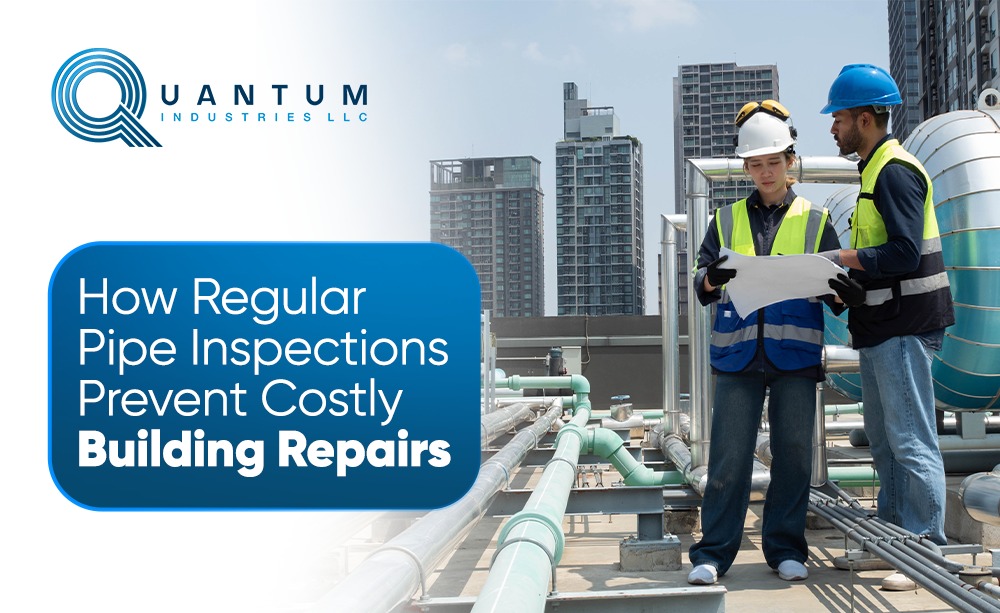
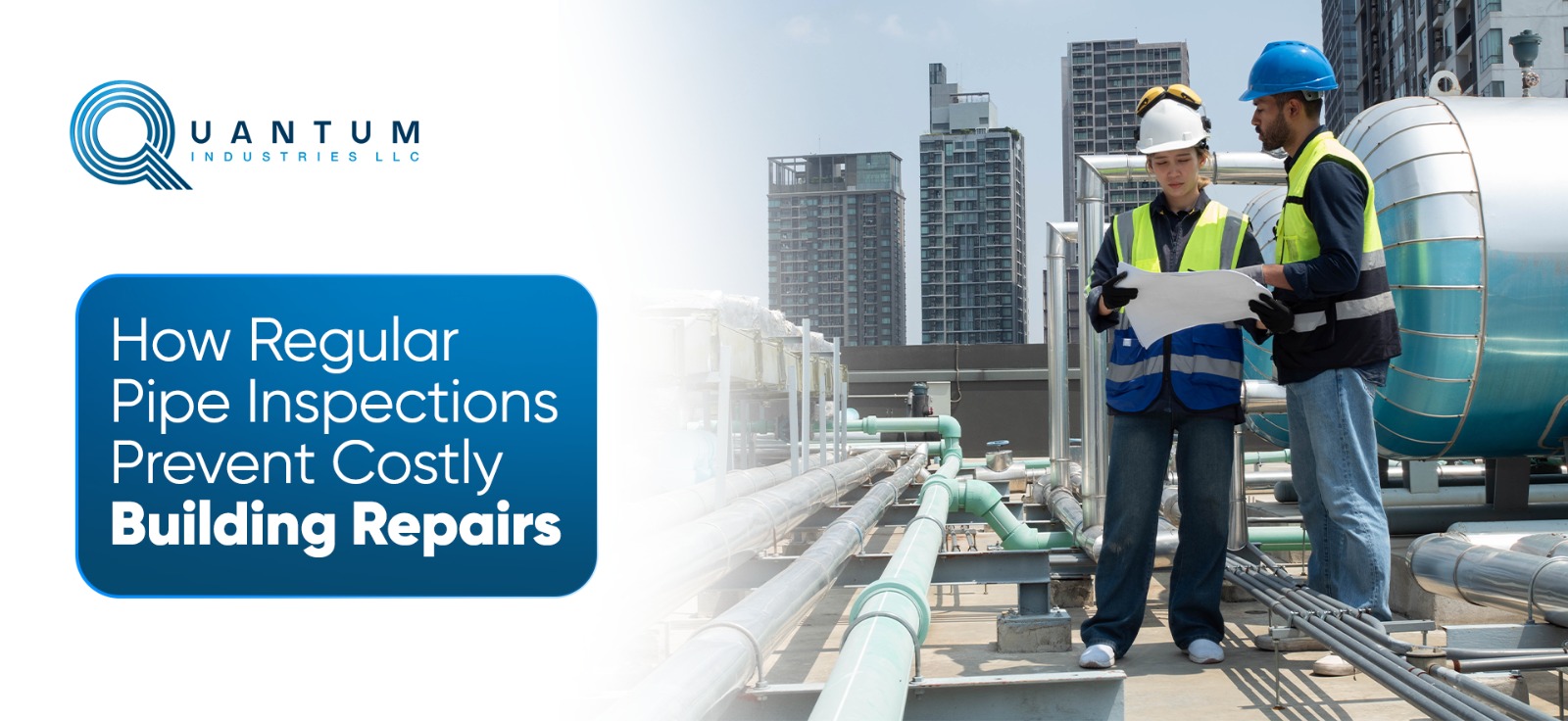
- Quarterly visual inspection: Check exposed pipe runs, junctions, supports, insulation, joint seals for signs of stress, bulging, vibration or corrosion.
- Annual pressure or flow test: For supply lines, check flow rates, pressure drop; for drainage, check flow, noise levels and inspect acoustic performance.
- On-hand checks during major renovation: If the building undergoes retrofit or heavy usage changes, inspect piping systems more closely (especially if older systems being reused).
- Record-keeping and traceability: Maintain logs of the inspections, record batch numbers of installed piping, note any remedial work. If a system fails, trace back to batch and installation date, and liaise with manufacturer under warranty.
- Training and on-site awareness: Ensure your maintenance staff or MEP contractor understands the certified system’s requirements (expansion loops, supports, correct weld or fusion procedures) and the manufacturer’s guidelines.
Why Quantum Industries is positioned as a trusted, transparent partner
Quantum Industries stands as a trusted and transparent partner in the UAE piping sector through its unwavering focus on quality, safety, and reliability. With internationally recognised certifications such as WRAS, DVGW, SKZ, and Exova, the brand assures customers of superior performance and compliance. Their products—from PP-R and PEX to acoustic drainage and HVAC systems—are engineered for durability and efficiency. By offering technical support and clear product guidance, Quantum Industries reinforces its reputation as a dependable manufacturer that values authenticity, builds trust, and delivers lasting confidence to contractors and end-users alike.
In an environment where building performance, occupant comfort and project lifecycle cost matter, relying purely on initial cost for piping systems is a false economy. The real value lies in choosing systems that are certified, verified, and supported, and then pairing them with regular inspections to detect issues early. For contractors, developers and MEP teams operating in the UAE, this approach protects budget, schedule and reputation.
By adopting a trusted pipe supplier in UAE like Quantum Industries, and verifying authenticity via certification, branding, labeling and traceability, you lay a strong foundation. Then by integrating regular inspections, visual, pressure or flow, documentation, you prevent small faults from becoming large failures.
True cost avoidance isn’t an accident: it’s a combination of smart product selection, vigilant inspection and trusted partnership. When you get that right, you not only prevent costly building repairs, you build confidence in your infrastructure for years to come.