In piping systems, system reliability and product quality are often discussed together. While they are closely linked, they serve different purposes. Product quality refers to the materials used, the design of components, and the standards followed during manufacturing. System reliability focuses on how the entire piping network performs over time, including its safety, stability, and ability to withstand pressure, temperature, and regular operating conditions.
Q-Therm piping systems bring these two aspects together in a practical way. Clear guidance is provided on materials, installation practices, jointing methods, safety requirements, and long-term performance expectations. By connecting these elements, Quantum Industries, one of the leading pipe suppliers in the UAE, ensures that high product quality directly supports dependable and reliable system performance.
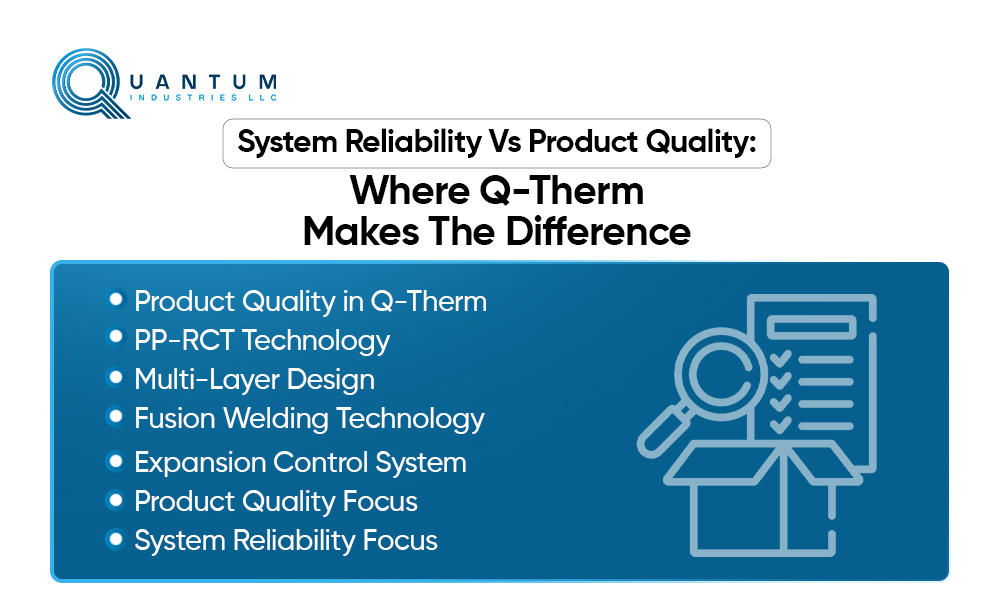
Product quality starts with materials, manufacturing, and design standards. Q-Therm is based on PP-R (Polypropylene Random Copolymer) and PP-RCT materials, which are widely used for potable water systems.
Q-Therm uses PP-R materials from established global manufacturers. These materials are chosen for their:
PP-R has been used globally for decades in drinking water systems, hot and cold water distribution, floor heating, radiator connections, and similar applications. This history is important because it shows long-term performance in real systems, not just lab testing.
PP-RCT is a modified version of PP-R. It uses a special nucleation process that improves the crystalline structure of the material. This leads to:
This improves product quality not by adding complexity, but by improving the core material structure.
Q-Therm also includes design features that improve performance:
These features are not decorative. They directly support durability, stability, and safety.
High-quality pipes alone do not create a reliable system. Reliability depends on how the full network is designed, installed, and maintained. This is where Q-Therm focuses strongly on system-level performance.
Q-Therm uses fusion welding methods such as:
In fusion welding, the pipe and fitting melt and join together. This creates a single continuous material joint, not a mechanical connection. The result is:
This directly supports system reliability because most failures in piping systems happen at joints, not in straight pipe sections.
Q-Therm systems include clear installation guidelines, which are critical for long-term performance.
Plastic pipes expand and contract with temperature changes. Proper system design addresses this movement through:
This means the system is designed to move safely, not fight against movement. Controlled movement prevents:
System reliability is not only about installation. It also includes daily operation and long-term use.
Q-Therm systems are designed for:
The materials are suitable for high working pressures and elevated temperatures.
Unlike metal pipes, Q-Therm systems are:
This improves system reliability by reducing internal damage, contamination, and pipe degradation.
Product quality also supports system reliability in health-related areas.
Q-Therm systems are:
This protects water quality and ensures stable long-term use in drinking water systems.
The piping system is designed to support:
This means systems can be repaired and modified without full replacement, which increases operational reliability over time.
Q-Therm systems are supported by:
This shows that reliability is built into procedures, not left to chance.
Product Quality Focuses On:
System Reliability Focuses On:
Q-Therm connects both. The product quality supports the system design, and the system design protects the product performance.
Q-Therm does not treat pipes as isolated products. It follows a complete system approach that considers:
This means the system is designed to work as one complete network, not just as separate components.
System reliability and product quality are not competing ideas. They depend on each other. A high-quality product without proper system design will fail. A well-designed system with poor-quality products will also fail.
Q-Therm makes the difference by connecting both sides:
The result is not just a good pipe, but a reliable piping system. Quantum Industries shows that true reliability comes from combining quality materials with proper system engineering, structured installation, and long-term performance planning.